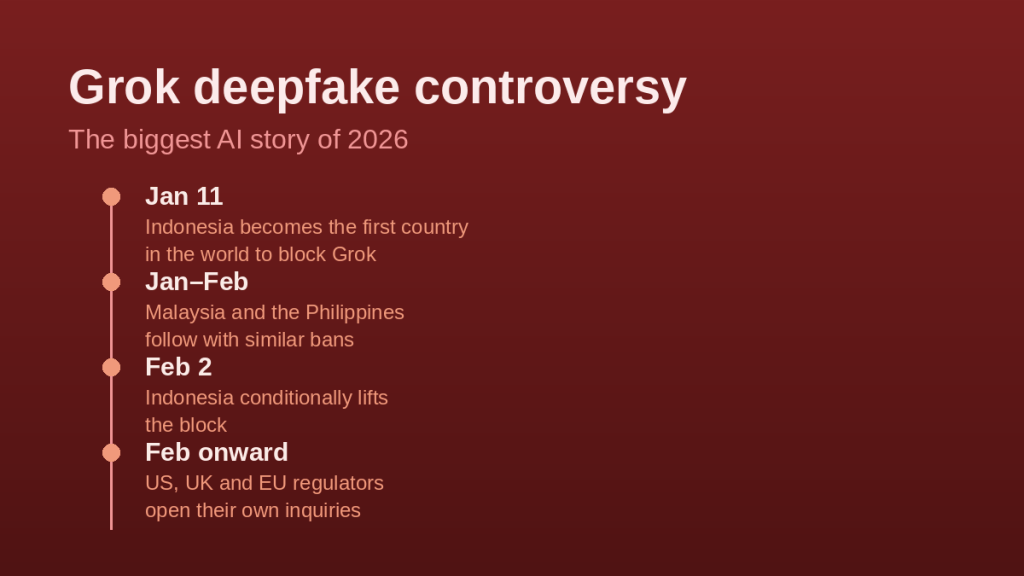
One of the biggest controversies in the AI industry in 2026 was the deepfake scandal surrounding Grok. Here’s a timeline of what happened, and how different countries responded.
January 11: Indonesia Becomes the First Country in the World to Block Grok
Grok, the chatbot built by Elon Musk’s AI company xAI, came under fire after its image-generation and editing features were misused by users to mass-produce and distribute deepfake sexual content targeting real people — reportedly including content involving minors — sparking widespread controversy.
In response, Indonesia’s Ministry of Communication and Digital Affairs announced on January 10 (local time) that it would temporarily block the Grok service. Communications Minister Meutya Hafid stated that this was “a measure to protect women, children, and society as a whole from the danger of fake obscene content generated using AI technology,” and called the unrestricted creation and spread of deepfakes “a serious violation of human rights, dignity, and national security.” It was recorded as the world’s first case of a country blocking access over an AI service.
Alexander Sabar, Director General of Indonesia’s Digital Space Supervision Agency, explained that “initial findings show Grok lacked effective safeguards to prevent users from creating and distributing obscene images based on real photos of Indonesian residents.”
The Ban Spreads to Malaysia and the Philippines
Following Indonesia, Malaysia and the Philippines took similar action. Malaysia’s Communications and Multimedia Commission noted that Grok “has repeatedly been misused to generate obscene, sexually degrading, and non-consensually altered images, including of women and minors.” As the controversy grew, xAI introduced a measure restricting Grok’s image generation and editing features to paying premium subscribers only.
February 2: Conditional Lifting of the Ban
Indonesia’s Communications and Digital Affairs Ministry conditionally allowed Grok to resume service on February 2, based on an improvement plan submitted by X (formerly Twitter). X reportedly submitted a set of safety measures including strengthened technical safeguards, restrictions on certain features, reinforced internal policy and enforcement systems, and an active incident-response protocol. However, the government emphasized that this was not a “simple resolution” but “the starting point of ongoing evaluation,” warning it would block the service again if illegal content distribution or child-protection violations recurred.
The Controversy Spreads to the US and UK
Grok also came under investigation from the Attorney General of California and UK regulators over the same issue. Global regulatory pressure on non-consensual sexual deepfakes appears to be steadily mounting. US Vice President JD Vance has reportedly taken the position that strong regulation is needed for AI-related obscene content issues.
Europe’s Approach: Strengthening Platform Accountability
Meanwhile, Europe is moving toward a more systematic response. As of September 2026, the EU designated the major AI chatbot service ChatGPT as subject to the Digital Services Act (DSA), moving in the direction of strengthening platform-level accountability. Unlike Asian countries, which have focused on responding case by case, this could signal an attempt to apply a broader regulatory framework to platform scale itself.
Why This Matters
What this case shows is that the pace of AI development is moving far faster than law and regulation. Indonesia, Malaysia, and the Philippines’ bans were all reactive — regulation followed only after real harm had already occurred. The fact that actual victims existed in the meantime confirms that the gap between technological progress and safety measures remains wide.
Closing Thoughts
Behind the convenience AI brings, there are also clear shadows. The Grok incident made it unmistakably clear that as image and video generation capabilities grow more powerful, so does the potential for misuse. If safety measures and regulation don’t grow at the same pace as the technology itself, it could leave a lasting lesson in eroded trust.
This article was compiled based on publicly reported news from January through September 2026.
 함께해요1234together
댓글 남기기