“Will AI really take over my job?” That question no longer has to be answered with vague anxiety — in 2026, we actually have the data to check. Here’s what recent surveys and reports in Korea and abroad have found.
The Anxiety Felt by More Than Half of Young Workers
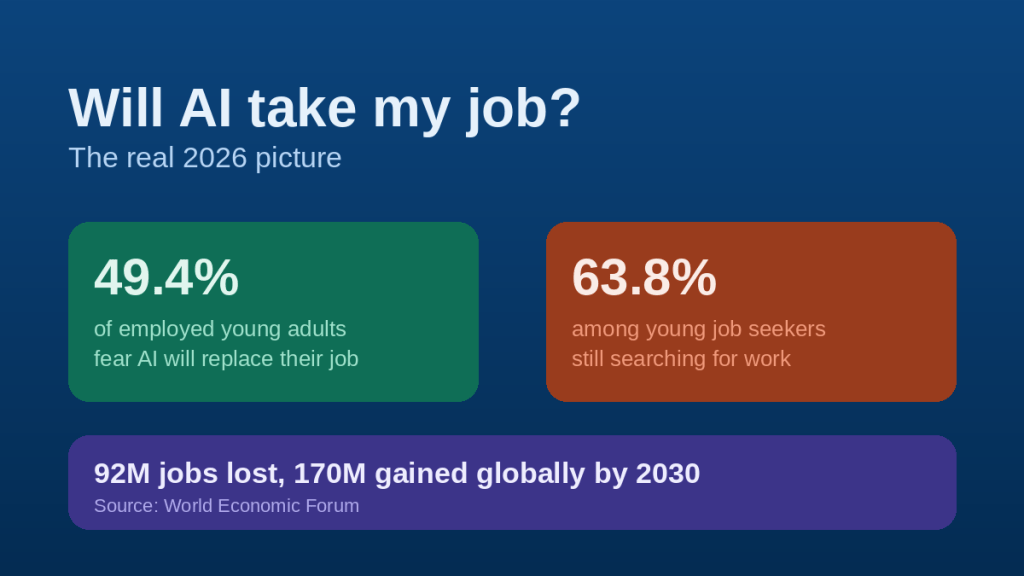
According to a survey published in August 2026, 49.4% of employed young adults said they believe “AI will replace my job within five years.” Among young people who are still job hunting, that number climbs to 63.8%. In other words, people still searching for work feel even more anxious about AI-driven job loss than those who already have a job.
Real Numbers Confirmed by the Bank of Korea
The Bank of Korea’s employment research team reported that between July 2022 and July 2025, 98.6% of the 211,000 jobs lost domestically occurred in industries “highly exposed to AI.” Youth employment losses were especially pronounced in fields where AI can easily replace entry-level work: computer programming/systems integration/management fell 11.2%, professional services such as law, accounting, tax, advertising, and consulting fell 8.8%, publishing fell 20.4%, and information services fell 23.8%.
Still, there are analyses that push back on this. Korea’s National Assembly Budget Office noted it could not find evidence that the spread of generative AI reduced hiring or new-hire demand in AI-exposed occupations — showing that even the same phenomenon is being interpreted differently.
Globally: 92 Million Jobs Lost, 170 Million Gained
The World Economic Forum projects that AI will eliminate 92 million jobs worldwide by 2030, while creating 170 million new ones — a net gain of roughly 78 million jobs. Goldman Sachs has estimated that AI could automate work equivalent to 300 million full-time jobs globally, and McKinsey Global Institute projects that 60–70% of individual tasks could be automated by 2030.
As of May 2026, analysis shows that major tech companies including Meta, Coinbase, and Cisco have already eliminated more than 92,000 jobs through AI-related restructuring.
Which Occupations Feel Most at Risk?
A 2026 survey of Korean office workers revealed an interesting paradox. IT/development workers, at 61.9%, use AI almost daily — the highest rate of any group — and 90.7% of them said they’ve experienced improved work efficiency, also the highest rate. Yet 69.1% of them also said “my job could be replaced by AI” — the highest of 12 occupational categories. In other words, the people using AI most actively are the ones who feel replacement is most realistic.
Service industry workers, by contrast, had the lowest sense of replaceability at 32.5%. When asked which occupations will survive longest even in the AI era, caregiving work ranked first at 42.6%, followed by hands-on technical trades (27.4%), agriculture and fisheries (22.8%), and medical professionals (19.5%). This reflects the belief that jobs requiring physical presence and emotional connection are harder for AI to replace.
So What Should We Prepare For?
- Turn AI skills into a direct competitive advantage: Like IT and development workers, the more you use AI daily, the more anxiety you may feel — but efficiency gains rise just as sharply. It’s better to get familiar with it than to fear it.
- Pay attention to areas where AI is relatively weak: Caregiving, in-person services, and hands-on technical work — fields requiring physical presence and emotional connection — are still rated as harder for AI to replace.
- Look at both sides of the data: As the gap between the Bank of Korea’s data and the National Assembly Budget Office’s analysis shows, this topic isn’t fully settled. There’s no need to be either overly discouraged or dismissive based on one set of numbers alone.
Closing Thoughts
The reality of 2026, once you look at the actual numbers, is neither “total replacement” nor “nothing to worry about.” It’s a complex transition period where young job seekers’ anxiety, real industry-by-industry hiring data, and the outlook for new job creation all coexist. What matters now isn’t vague fear or baseless reassurance — it’s taking a clear-eyed look at how your own job is actually changing, based on data.
This article was written based on 2026 data and domestic survey results from the Bank of Korea, the World Economic Forum, Goldman Sachs, McKinsey Global Institute, and others, for general informational purposes.
 함께해요1234together
댓글 남기기